Teaching
A brief sample of recent courses taught at University of Maryland, Baltimore County. Get in touch for resources, syllabi, or more information.
Baltimore Poetry and Politics
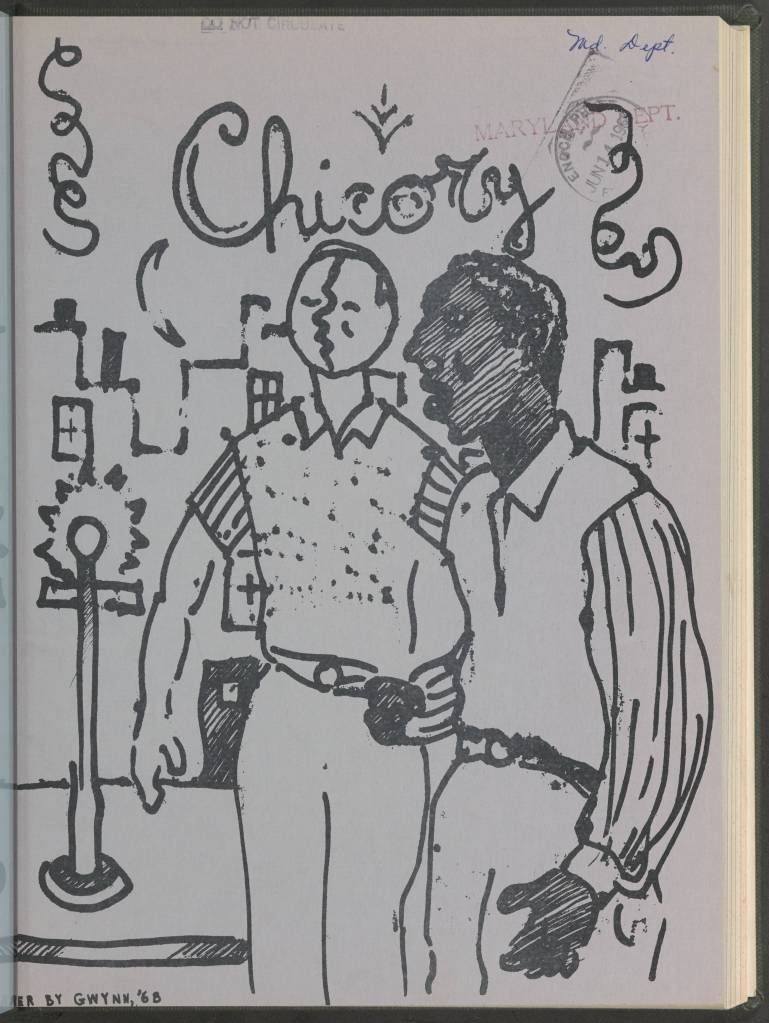
This class investigates the connection between poetry and politics in the communities surrounding UMBC. We begin with historical background of Baltimore and readings about what it means to be what Langston Hughes calls a “social poet.” Then, to focus on the relation between local events, social justice, and literature, students engage Black Arts Movement literature, poems about the 2015 uprising, Baltimore #BlackLivesMatter, queer and trans* rights, and red-lining and underinvestment in the city. In 2021, with the help of a grant from the Humanities Teaching Lab at the Dresher Center, this course was taught with six community partners covering three units: “Defining Poetry and Politics in Baltimore,” “Baltimore Black Arts Movement,” and “The Uprising” and “Poetry Now.” In 2025, students in this course had the opportunity to contribute to The Soul of the Butterfly, a traveling exhibition about Baltimore’s Black Arts Movement magazine Chicory, which was on display at the Albin O. Kuhn Library & Gallery. (ENGL 243)
The image above is the cover of the June 1968 issue of Chicory.
Experimental Writing by Women: Race, Gender, and the Avant-Garde
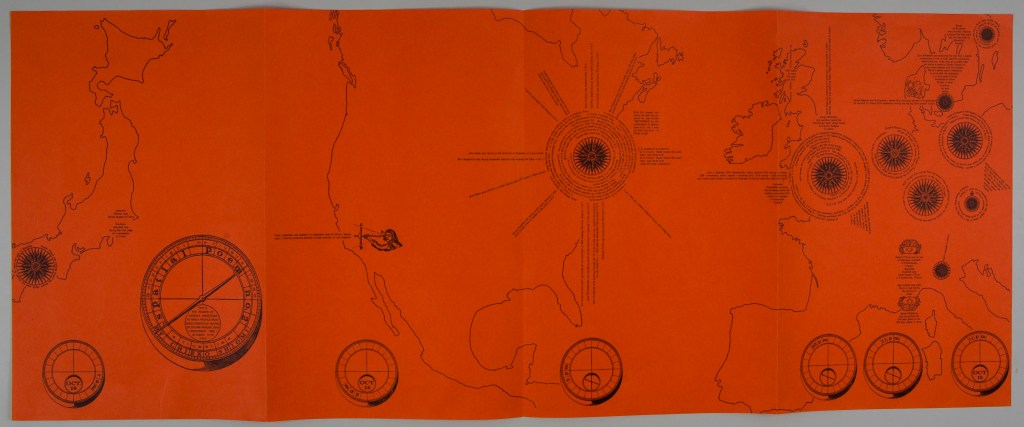
This course examines multiple feminist theories of writing as we trace the relationship of the categories “experimental” and “avant-garde” to gender and race. From the women-run Little Review, the central outlet for modernist texts of the 1920s, to recent debates about the “whiteness of the avant-garde,” we will study how women-identified people respond to white supremacist hetero-patriarchy with experimentation in literary form and textual circulation. Special attention will be given to hybrid and interdisciplinary forms such as autotheory, performance, and multimedia works. (ENGL 364/ GWST 364, crosslisted)
The image above is Mieko Shiomi, “Spatial Poem,” 1965.
Literary Methodologies Research
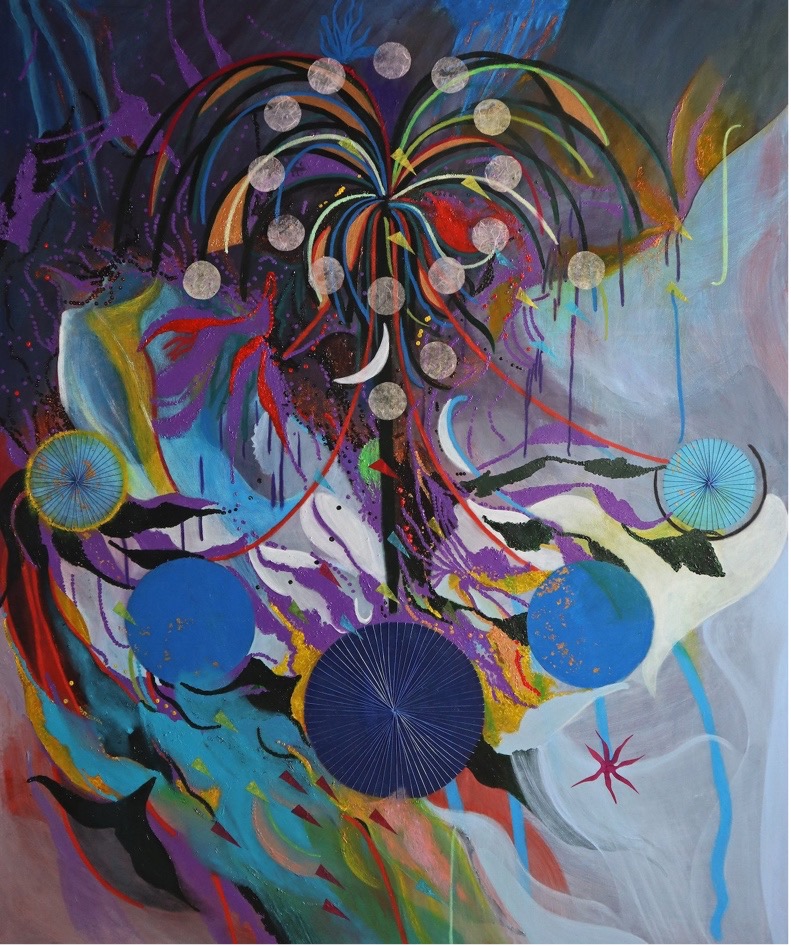
This course is an introduction to contemporary literary theories and methodologies for English majors in the Literature Track. Students will acquire an understanding of the history and methods of theoretical approaches underlying contemporary literary studies. Students will wield these methods to analyze a variety of texts, and they will develop a theoretically informed research-based project of their own design. (ENGL 302)
The image above is Tiffanie Delune, “Epiphanies,” Mixed media on cotton canvas, 2023.
Poetry in the Office…Poetry in the Streets!
This class is an exploration of the category of poetry and its meaning to public life in the United States from the 1960s to present. The course is centered around three units, each of which will have an experiential component, including study in archives, working with UMBC special collections, and a field trip in Baltimore: 1) “Poetry in the Office: Fluxus” will cover poetry that engages and critiques white-collar work, just as the U.S. moved from an industrial to a primarily administrative economy (1960s). 2) “Poetry in the Streets: The Black Arts Movement” will cover the interdisciplinary, politically engaged social poetry of BAM, which carved out a separate space for African American culture (1970-80s). 3) “Poetry in the Streets: Environmental Justice,” will cover poetry about the intersection of capitalism, discrimination, and environmental destruction from the 90s to present. It will consider why environmental catastrophe is felt unevenly along race and class and how poetry informs activism. (ENGL 448/ENGL 648, senior seminar/graduate seminar.)
Revolution in Form: U.S. Modernism
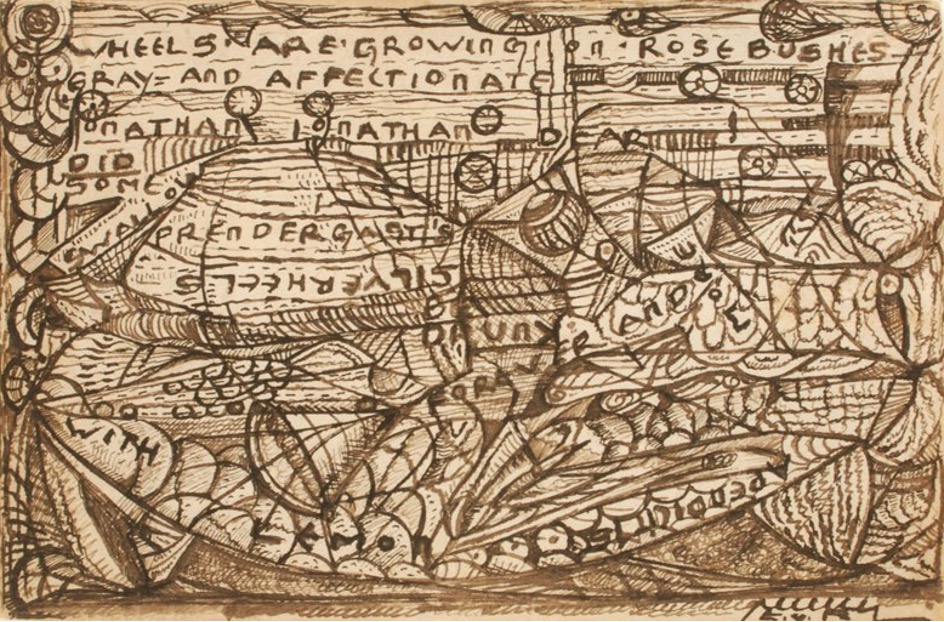
This course studies how U.S. literature responds to four major changes of the era from the Civil War to the midcentury: changing notions of gender or “first wave” feminism; the rise of industrial capitalism; the impacts of the World Wars; the Great Migration and new racial imaginaries. Our special focus will be on how experimentation in literary form—including modernist fragmentation and avant-gardism, for example—responds to each of these categories, describing, unraveling, shaping, and critiquing them. To this end, we will explore readings by authors as diverse as Emily Dickinson, Langston Hughes, the Baroness Elsa von Freytag Loringhoven, Gertrude Stein, Amiri Baraka, T.S. Eliot, and Yoko Ono. (ENGL 308)
The image above is a poem/drawing by the Baroness Else von Freytag Loringhoven (1922).
“Poetry and Capitalism”
How have poets responded to changes in political economy in the United States since 1960? Poetry is often a mode of resistance, critique, and illumination of shifts in capitalism that drive both labor and everyday life. We will study poets’ responses to the decline of the welfare state, corporatization, and racial liberalism. We will also consider neoliberalism, an economic and cultural project that sediments gender, racial, and class-based disparities through privatization. Our focus will be on poetry that creates experimental alternatives. Units include: Fluxus (the 1960s), the New York School (1960-1970s), the Black Arts Movement (1970s), Language Poetry (1970-1980s), and Documentary and Conceptual Poetry (1990-present). (ENGL 448/ENGL 648, senior seminar/graduate seminar.)
 Keegan C. Finberg